Connect with us

David Geller: Bring Your Shop Out of the Dark

mm

Published

on

Bench profitability shouldn’t be a guessing game.


This article originally appeared in the January 2015 edition of INSTORE.

Life is a little less complicated when you sell from the showcase — you know your cost: just double it (more or less). But when it comes to shop-pricing, the question of how much to charge is a guess for most jewelers. Many don’t even know their shop’s profitability.

So here I’m going to try to make it a little easier to understand. Let’s take a store that has one jeweler (just multiply these numbers if you have two or more jewelers), and assume the following:

Jeweler works a 40-hour week.

Has more work than he/she can complete in a day.

Advertisement

Is uninterrupted about 80 percent of the day.

With a lot of repair work and a fair amount of custom work, your jeweler should produce $190,000 to $300,000 a year in shop sales.
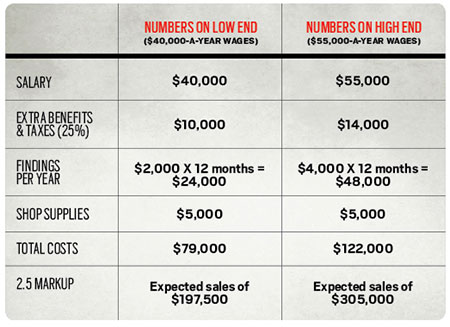
anticipated jeweler profit chart

My figures are based on what my store did (our five bench jewelers did a little over $250,000 per bench over 15 years ago) and what I see in shops across the country from my consulting work.

Not convinced you can replicate this level of profitability in your shop? Here’s a breakdown of how it’s done:

Jewelers are paid between $40,000 to $55,000 a year or more (these are full-time employees not 1099 hires).

Advertisement

Your findings and material costs per month range from $2,000 to $4,000 a month.

You spend about $5,000 a year on miscellaneous tools and shop supplies.

Crucially, you target a 3.0 time markup (although with problems and redos expect an ultimate 2.5 time markup).

So let’s look at how that adds up:

Why the difference in higher and lower numbers? It’s related to how much custom you do compared with total shop sales and the size of your average repair sale. Your shop sales will be lower if your jeweler spends most of his time sizing rings and fixing tips/prongs/clasps. We did a lot of intricate repair such as shanks, new heads, and restoration work.

If you have less skilled jewelers who can only do simpler repairs, their pay should be lower. But if you have a fine jeweler who can do almost anything, he should be paid a higher wage. You may be surprised, but I know many store-owners paying $60,000 to $70,000 a year for a bench jeweler.

Advertisement

Bench productivity is obviously an issue, and training the sales staff to better sell shop sales reduces jewelers’ interruptions. But the biggest factor to producing the numbers above is to raise your repair and custom prices. Plain and simple. It will work and you’ll keep the majority of your repair and custom customers, because:

Repairs are not price sensitive, they are trust sensitive.

Most repairs have a 90-percent closing ratio no matter what price they charge.

Custom design has a 70-80 percent closing ratio.

Meanwhile, selling from the inventory-laden showcase has a 25-50 percent closing ratio, typically closer to 30 percent.


David Geller is a consultant to jewelers on store management. Email him at dgellerbellsouth.net.

Advertisement

SPONSORED VIDEO

Closing With Confidence: How Bailey's Fine Jewelry Achieved Outstanding Results With Wilkerson

When Trey Bailey, President and CEO of Bailey's Fine Jewelry, decided to close the Crabtree location in Raleigh, North Carolina after 15 years, he knew the decision needed to be handled with intention and professionalism. The goal was clear: exit the location while maintaining financial strength and honoring the store's legacy. Having worked with Wilkerson successfully in the past, Bailey understood the value of their comprehensive approach. "They understood both the emotional and financial sides of the store closing sale," Trey explains. "Their reputation for professionalism, results and care made it a very easy decision." The results exceeded expectations. Wilkerson helped Bailey's sell through significant inventory while maintaining the dignity of the closing process. "They don't just run a sale, they help close a chapter in the best way possible," Bailey says, strongly recommending Wilkerson to any jeweler facing a similar transition.

Promoted Headlines

Most Popular

David Geller

David Geller: Bring Your Shop Out of the Dark

mm

Published

on

Bench profitability shouldn’t be a guessing game.


This article originally appeared in the January 2015 edition of INSTORE.

Life is a little less complicated when you sell from the showcase — you know your cost: just double it (more or less). But when it comes to shop-pricing, the question of how much to charge is a guess for most jewelers. Many don’t even know their shop’s profitability.

So here I’m going to try to make it a little easier to understand. Let’s take a store that has one jeweler (just multiply these numbers if you have two or more jewelers), and assume the following:

Jeweler works a 40-hour week.

Has more work than he/she can complete in a day.

Advertisement

Is uninterrupted about 80 percent of the day.

With a lot of repair work and a fair amount of custom work, your jeweler should produce $190,000 to $300,000 a year in shop sales.

anticipated jeweler profit chart

My figures are based on what my store did (our five bench jewelers did a little over $250,000 per bench over 15 years ago) and what I see in shops across the country from my consulting work.

Not convinced you can replicate this level of profitability in your shop? Here’s a breakdown of how it’s done:

Jewelers are paid between $40,000 to $55,000 a year or more (these are full-time employees not 1099 hires).

Advertisement

Your findings and material costs per month range from $2,000 to $4,000 a month.

You spend about $5,000 a year on miscellaneous tools and shop supplies.

Crucially, you target a 3.0 time markup (although with problems and redos expect an ultimate 2.5 time markup).

So let’s look at how that adds up:

Why the difference in higher and lower numbers? It’s related to how much custom you do compared with total shop sales and the size of your average repair sale. Your shop sales will be lower if your jeweler spends most of his time sizing rings and fixing tips/prongs/clasps. We did a lot of intricate repair such as shanks, new heads, and restoration work.

If you have less skilled jewelers who can only do simpler repairs, their pay should be lower. But if you have a fine jeweler who can do almost anything, he should be paid a higher wage. You may be surprised, but I know many store-owners paying $60,000 to $70,000 a year for a bench jeweler.

Advertisement

Bench productivity is obviously an issue, and training the sales staff to better sell shop sales reduces jewelers’ interruptions. But the biggest factor to producing the numbers above is to raise your repair and custom prices. Plain and simple. It will work and you’ll keep the majority of your repair and custom customers, because:

Repairs are not price sensitive, they are trust sensitive.

Most repairs have a 90-percent closing ratio no matter what price they charge.

Custom design has a 70-80 percent closing ratio.

Meanwhile, selling from the inventory-laden showcase has a 25-50 percent closing ratio, typically closer to 30 percent.


David Geller is a consultant to jewelers on store management. Email him at dgellerbellsouth.net.

Advertisement

SPONSORED VIDEO

Closing With Confidence: How Bailey's Fine Jewelry Achieved Outstanding Results With Wilkerson

When Trey Bailey, President and CEO of Bailey's Fine Jewelry, decided to close the Crabtree location in Raleigh, North Carolina after 15 years, he knew the decision needed to be handled with intention and professionalism. The goal was clear: exit the location while maintaining financial strength and honoring the store's legacy. Having worked with Wilkerson successfully in the past, Bailey understood the value of their comprehensive approach. "They understood both the emotional and financial sides of the store closing sale," Trey explains. "Their reputation for professionalism, results and care made it a very easy decision." The results exceeded expectations. Wilkerson helped Bailey's sell through significant inventory while maintaining the dignity of the closing process. "They don't just run a sale, they help close a chapter in the best way possible," Bailey says, strongly recommending Wilkerson to any jeweler facing a similar transition.

Promoted Headlines

Advertisement

Advertisement

Subscribe


BULLETINS

INSTORE helps you become a better jeweler
with the biggest daily news headlines and useful tips.
(Mailed 5x per week.)

Advertisement

Most Popular