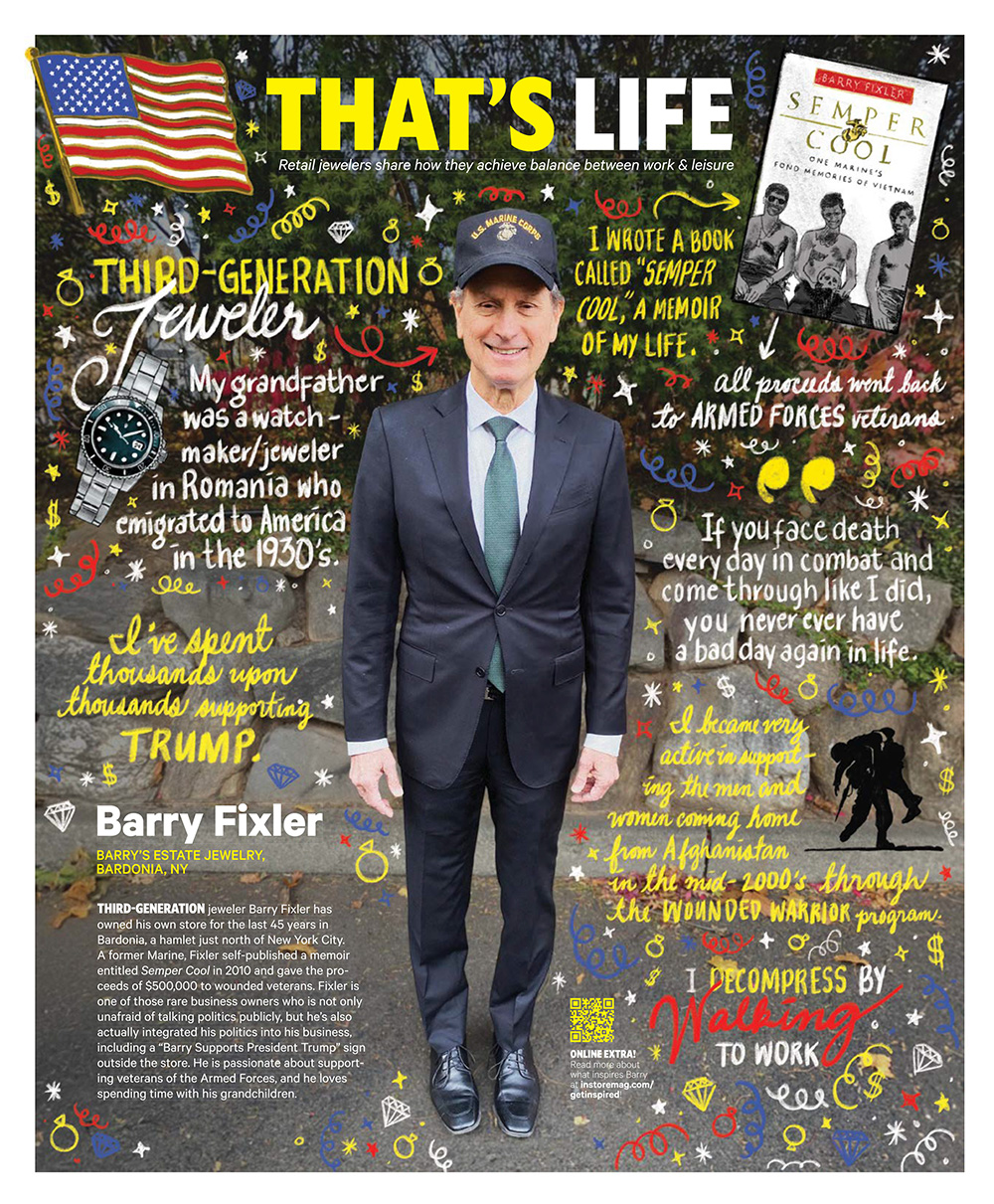
Barry Fixler
Barry’s Estate, Jewelry, Bardonia, NY
Third-generation jeweler Barry Fixler has owned his own store for the last 45 years in Bardonia, a hamlet just north of New York City. A former Marine, Fixler self-published a memoir entitled “Semper Cool” in 2010 and gave the proceeds of $500,000 to wounded veterans. Fixler is one of those rare business owners who has turned his store into something bigger than a business — a community clubhouse where veterans drop by just to talk, parents of service members stop in for moral support, and nervous grooms end up sharing counter space with all of them.
Q&A with Barry Fixler
How did you get into the jewelry business?
My father had three jewelry stores. My grandfather had a store down the road, and I had three uncles with jewelry stores. I grew up in the business. My grandfather on my mother’s side was a jeweler in Romania in the 1920s and 30s. In the late 30s, Hitler became a terrible person to the Jews. My grandfather had six children, the youngest being my mom. My grandfather was fortunate to come to America in the mid 30s; my mom was maybe 5 years old. He settled in Queens and he had a jeweler’s bench in lower Manhattan on Canal Street. When World War II began, my father spent four and a half years in the Pacific in the Army, came out of the service, met my mom, and they all lived in the Bronx. They were married in 1946. A year or two later, they had me. My father learned the jewelry business from my grandfather. He had no trade at all; he went into the Army at 20 and came out with no skills five years later. As years went on, my grandfather had three sons, and two of them became jewelers in the NY/NJ area. I graduated high school in 1967, joined the service and was in the Vietnam War for the next three years. I came out in the early 70s. My obligation was six years. When I came out of the service, my father asked me to come into the business. He had three stores; the main one was in Queens. He was there for 35 years. I was in my early 20s and found it very tough working for my father, so I went to GIA and took the residency course and the correspondence course. I graduated around 1978. It was really tough to become a gemologist back then. Fast forward, I was butting heads with my father and decided to go into business for myself around 1981. I’ve been in this location for 35 years. I’m in a suburban area, middle to upper class, I’m 19 miles outside of New York City. The key to my success and my passion is that I served in the Armed Services and was a Marine for six years. I became very active in Wounded Warriors around 2005-2006. Unfortunately, the government dropped the ball in the mid-2000s and I kicked in hundreds of thousands of dollars to help wounded veterans. After working with mostly amputees, I was inspired by them.
What are your hobbies outside of work?
I don’t watch TV. I do read. I have to read an hour a day. I can’t go to sleep without reading. If it was up to me, I’d be reading all day long. I can only read non-fiction; I read books that inspire me. I read Elon Musk’s book, Churchill’s book, Patton’s book. I just finished reading Ronald Reagan’s book. When I was younger, I rode horses and always had a horse through my 40s. Once I got married and had children, things changed.
Why did you write your memoir “Semper Cool,” and what was that writing process like?
I was inspired by the men and women who lost limbs in combat and how courageous they are. And my community, every time I had a fundraiser, I had thousands of well-wishers for the veterans to come to my store and help me raise money for them.
The writing process for “Semper Cool” was grueling. It took me four and a half years to write it. I’m very fortunate that I wrote a diary, so I had tons of paper to fall back on. The book is non-profit; the half a million dollars in sales went to our wounded veterans. I paid for everything to publish the book and went all over the country to be a guest speaker. It probably cost me $200,000-$300,000 to give back $500,000 to the veterans. I was very inspired by the veterans and how the American people will support them.
Advertisement
Tell me about your family.
My wife is a retired nurse, my daughter is an economist, she’s very intellectual. Her name is Desiree Fixler. She lives with her three children in London.
Do you have any pets? What’s your ideal day off?
My wife and I have a four-year-old Golden Doodle named Della, so I get up in the morning, she looks up at me, and as soon as I put on my sweatshirt, she knows I’m going to walk her. We’re both grandparents and my dog is stuck with us.
What’s your ideal vacation spot?
Since I’m so involved with the veterans, I haven’t taken a vacation since before the pandemic. My wife and children go to Florida. Every day I come to work, I love it. I work with lovely people. People think of my store as like a clubhouse. I have veterans who come in just to talk, parents who have sons and daughters serving in the Armed Forces who want to talk.
Do you wear jewelry?
I always wear a white shirt and tie. I have cuff links, my wedding ring (platinum), a platinum pinky ring, a Gucci bracelet, a Miami Cuban link bracelet, and a cable link bracelet.
How do you decompress during or after the holiday rush?
I’m very fortunate that I walk to work. Unless it’s cold and snowy. My daughter comes in from London with my grandchildren and I take them to the city to see a show or have dinner. I love to spend a week with them to decompress. If there’s a basketball game or a Rangers game, I take them to it.
